Support our educational content for free when you purchase through links on our site. Learn more
🏆 Top 5 Automakers in the World (2026): Who Really Rules?


Who actually sits on the throne of the global automotive empire? While headlines scream about Tesla’s valuation or BYD’s electric surge, the real battle for the crown is fought in the assembly lines of the traditional giants. In this deep dive, we cut through the noise to reveal the top 5 automakers by worldwide sales volume for 2026, exposing why the “Big 3” of the past have evolved into a complex global coalition. You might be surprised to learn that one of these titans recently overtook a century-old American icon to claim the #4 spot, and another is quietly dominating the hybrid market while the world rushes toward pure electric. We’ll break down their strategies, their struggles, and which brand truly offers the best value for your next ride.
Key Takeaways
- Toyota remains the undisputed global leader in sales volume, leveraging a hybrid-first strategy that outpaces pure EV adoption.
- Volkswagen Group and Stellantis dominate the European and North American truck markets respectively, utilizing platform sharing to maximize efficiency.
- Hyundai Motor Group has surged past General Motors to secure the #4 spot, driven by aggressive design and industry-leading warranties.
- Ford holds the #5 position, relying on the F-Series truck dominance and a cautious but steady transition to electric vehicles.
- BYD is the rising challenger, rapidly closing the gap on Tesla in EV volume, signaling a major shift in the global power balance.
Ready to find your perfect match? Explore our detailed breakdowns of each brand’s lineup below.
- Shop Toyota Models
- Explore Volkswagen & Audi
- Discover Jeep & Ram
- Browse Hyundai & Kia
- Find Ford Trucks & SUVs
Table of Contents
- ⚡️ Quick Tips and Facts
- 📜 The Evolution of Global Automotive Giants
- 🏆 The Top 5 Automakers by 2025 Worldwide Sales Volume
- 1. Toyota Motor Corporation: The King of Consistency
- 2. Volkswagen Group: The European Powerhouse
- 3. Stellantis: The Merged Giant
- 4. Hyundai Motor Group: The Korean Contender
- 5. Ford Motor Company: The American Icon
- 📊 Production Overview and Market Share Analysis
- 🔋 The Electric Vehicle Revolution: Who Leads the Charge?
- 🌍 Regional Dominance: Where Do These Giants Rule?
- 💡 Quick Tips and Facts
- 📚 Recommended Links
- ❓ Frequently Asked Questions
- 📖 Reference Links
⚡️ Quick Tips and Facts
Before we dive into the engine room of the global auto industry, let’s hit the nitrous boost with some rapid-fire facts that will make you sound like a seasoned pit crew chief at your next car meet.
- The Titans: The global market isn’t just a free-for-all; it’s a duopoly of giants (Toyota and VW) fighting for the crown, with a fierce pack of three chasing them down.
- The Shift: We aren’t just counting metal anymore; we are counting kilowatt-hours. The definition of “top” is shifting from pure volume to electrification readiness.
- The Surprise: While Tesla grabs headlines for value, BYD is quietly crushing volume records, proving that the future isn’t just American or German—it’s increasingly Chinese.
- The Reality Check: Not every “top 5” list is created equal. Some rank by market cap (Wall Street’s love letter), while others rank by units sold (the actual cars hitting the pavement). We’re focusing on the latter because, frankly, we care about the cars you can actually buy.
If you’re wondering how we got here, or why your favorite brand might be missing from some lists, stick around. We’re about to peel back the hood on the evolution of automotive dominance.
For more on the legends that paved the way, check out our deep dive: What Are 3 Famous Car Brands? Discover the Legends of 2025 🚗.
📜 The Evolution of Global Automotive Giants
The story of the top automakers isn’t just a spreadsheet; it’s a drama of mergers, bankruptcies, and reinventions. Imagine a high-stakes poker game where the chips are factories and the stakes are global dominance.
From Assembly Lines to Global Conglomerates
In the early 20th century, the game was simple: build a car, sell a car. Ford revolutionized this with the moving assembly line, making cars accessible to the masses. But as the world became smaller, the game changed.
- The Merger Mania: Remember when Fiat and Chrysler shook hands? Or when PSA (Peugeot/Citroën) merged with FCA to form Stellantis? These weren’t just corporate mergers; they were survival strategies. As noted industry reports, “All ten largest automakers by production as of 2017 remained in the top 10 before the 2021 merger,” but the landscape shifted dramatically once those mergers hit.
- The Electric Pivot: The 2020s brought a new challenger: Electrification. Traditional giants like Volkswagen and GM are pouring billions into EVs, while newcomers like BYD and Tesla are leading the charge.
Why the Rankings Change
You might notice that General Motors dropped from #3 to #4 in recent years. Why? Because Hyundai Motor Group (Hyundai, Kia, Genesis) has been on a tear, surpassing GM in sales volume. Meanwhile, Stellantis entered the fray as a merged entity, instantly catapulting into the top 5.
“The data distinguishes between ‘sold vehicles’ (2018–2025) and ‘production volumes’ (201–2017).” — OICA & F&I Tools USA
This distinction is crucial. Production tells you what’s rolling off the line; Sales tells you what people actually want. And right now, the world wants reliability (Toyota) and value (Hyundai/Kia).
For a deeper look at how these shifts happened, explore our Car Brand Histories category.
🏆 The Top 5 Automakers by 2025 Worldwide Sales Volume
Alright, buckle up. This is the main event. Based on the most recent data from 2024 and projections for 2025, here are the five kings of the road. We’re ranking them by global sales volume, because at the end of the day, the car that sells the most wins the popularity contest.
But wait—why did we leave Tesla out of the top 5? Great question! While Tesla is a titan in market capitalization and EV innovation, their total unit sales (around 1.79 million in 2024) don’t yet match the sheer volume of the traditional giants who sell 6 to 10 million units a year. Tesla is the spearhead, but these five are the army.
1. Toyota Motor Corporation: The King of Consistency
🏅 Rank: #1 Worldwide
📍 Headquarters: Toyota City, Japan
🚗 Key Brands: Toyota, Lexus, Daihatsu, Hino
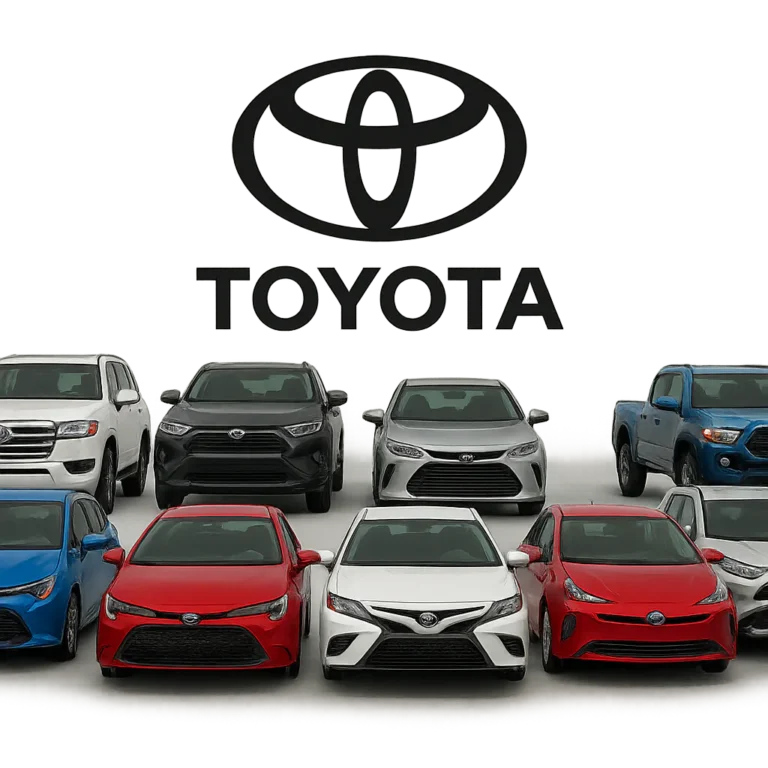
If the automotive world were a marathon, Toyota wouldn’t just be winning; they’d be setting the pace for everyone else. With over 10 million vehicles sold annually, Toyota is the undisputed heavyweight champion.
Why They Rule
- The “Kaizen” Philosophy: Toyota’s secret sauce is Kaizen (continuous improvement). They don’t just build cars; they build systems that build cars. This results in legendary reliability.
- Hybrid Dominance: While others rushed to go all-electric, Toyota doubled down on hybrids. The Prius and RAV4 Hybrid are selling like hotcakes, proving that the transition to green energy doesn’t have to be an overnight shock.
- Global Reach: From the rugged Tacoma in the US to the Corolla in Southeast Asia, Toyota is everywhere.
“Toyota stands as a symbol of reliability and efficiency in the automotive world.” — Forbes India
✅ Pros:
- Unmatched resale value.
- Massive dealer network for service.
- Hybrid technology that actually works.
❌ Cons:
- Infotainment systems often lag behind competitors.
- Conservative design language (some call it boring).
🔍 Deep Dive:
Toyota’s strategy is a masterclass in risk management. While competitors bet the farm on pure EVs, Toyota kept their foot on the gas (and the hybrid battery). This has paid off as supply chain issues and charging infrastructure gaps have slowed the EV transition globally.
Check out the latest Toyota models on Toyota Official Website | Search Toyota on Edmunds
2. Volkswagen Group: The European Powerhouse
🏅 Rank: #2 Worldwide
📍 Headquarters: Wolfsburg, Germany
🚗 Key Brands: Volkswagen, Audi, SEAT, Škoda, Porsche, Bentley, Lamborghini, Bugatti
If Toyota is the reliable marathon runner, Volkswagen Group is the Swiss Army Knife of the auto world. They own everything from the affordable Polo to the hyper-exclusive Bugatti.
The Strategy
VW’s “Platform Strategy” is genius. They build one chassis (like the MQB or MEB platforms) and slap different badges on it. This allows them to produce millions of cars efficiently while offering a car for every budget.
- The EV Gamble: VW is going all-in on the ID. series. The ID.4 and ID.Buzz are their answers to the Tesla Model Y and the classic VW Bus.
- Luxury Portfolio: Owning Porsche and Audi gives them a massive profit margin boost, subsidizing the mass-market VW brand.
✅ Pros:
- Incredible variety of vehicles.
- Strong engineering and driving dynamics.
- Agressive EV rollout.
❌ Cons:
- Software glitches in newer EV models.
- Brand dilution (too many brands under one roof).
🔍 Deep Dive:
VW’s journey hasn’t been smooth. The “Dieselgate” scandal was a massive blow, but they’ve used it as a catalyst to pivot hard toward electrification. Their goal is to be the world’s largest EV manufacturer by 2025. It’s a high-stakes gamble, but one that’s starting to pay off.
Explore the VW lineup on Volkswagen Official Website | Find VW deals on TrueCar
3. Stellantis: The Merged Giant
🏅 Rank: #3 Worldwide
📍 Headquarters: Amsterdam, Netherlands
🚗 Key Brands: Jeep, Ram, Dodge, Chrysler, Peugeot, Citroën, Fiat, Alfa Romeo, Maserati, Opel, Vauxhall, Lancia, DS, Abarth
Stellantis is the automotive equivalent of a frankenstein monster, but a very successful one. Formed in 2021 by the merger of Fiat-Chrysler (FCA) and PSA Group, they instantly became a top 5 player.
The Power of 14 Brands
Stellantis doesn’t just have one identity; they have fourteen. This allows them to dominate specific niches:
- Jep: The undisputed king off-roaders.
- Ram: The best-selling truck brand in the US (beating Ford and GM in some metrics).
- Peugeot/Citroën: European style and efficiency.
- Maserati/Alfa Romeo: Italian flair (though these brands are currently struggling, as we’ll see later).
✅ Pros:
- Unbeatable truck and SUV lineup in North America.
- Strong presence in Europe and South America.
- Diverse portfolio mitigates risk.
❌ Cons:
- Brand identity confusion (why does a Maserati share parts with a Jeep?).
- Some luxury brands (Alfa Romeo, Maserati) are facing severe sales slumps.
🔍 Deep Dive:
The merger was a masterstroke for volume, but it’s a challenge for culture. Integrating the “American muscle” of Dodge with the “French chic” of Peugeot is no small feat. However, their STLA Large and STLA Medium platforms are promising to unify their EV future.
Note: As mentioned in recent industry analysis, brands like Alfa Romeo and Maserati are facing significant struggles, with dealerships reporting high inventory and declining sales.
View Stellantis brands on Stellantis Official Website | Shop Jeep on Auto Trader
4. Hyundai Motor Group: The Korean Contender
🏅 Rank: #4 Worldwide
📍 Headquarters: Seoul, South Korea
🚗 Key Brands: Hyundai, Kia, Genesis
Ten years ago, Hyundai was a budget brand. Today, they are a design and tech powerhouse. Surpassing General Motors to take the #4 spot (and sometimes #3 depending on the quarter) is a massive achievement.
The Rise of the “K-Cars”
Hyundai and its sister brand Kia have completely reinvented their image.
- Design: The Kia EV9 and Hyundai Ioniq 5 look like they rolled out of a sci-fi movie.
- Value: They offer features that cost extra on German cars as standard equipment.
- Genesis: Their luxury division is finally giving Lexus and Mercedes a run for their money.
✅ Pros:
- Industry-leading warranties (10-year/10,0-mile powertrain).
- Cutting-edge EV technology (80V architecture).
- Agressive pricing.
❌ Cons:
- Resale value historically lower than Toyota (though improving).
- Some early EV models had software tething issues.
🔍 Deep Dive:
Hyundai’s strategy is simple: Out-design, out-tech, and out-value. They aren’t afraid to take risks. The Ioniq 5 won World Car of the Year, and the Kia EV6 is a best-seller. They are proving that you don’t need 10 years of history to build a world-class car.
Explore Hyundai models on Hyundai Official Website | Check Kia inventory on Edmunds
5. Ford Motor Company: The American Icon
🏅 Rank: #5 Worldwide
📍 Headquarters: Dearborn, Michigan, USA
🚗 Key Brands: Ford, Lincoln
Ford is the heart of American automotive. While they’ve dropped to #5 in global volume (surpassed by Hyundai), they remain a titan in the US and a leader in trucks.
The Truck Empire
The F-Series has been the best-selling vehicle in the US for over 40 years. That’s not just a stat; it’s a cultural phenomenon.
- Electric Trucks: The F-150 Lightning and Mustang Mach-E show Ford is serious about EVs, even if they’ve faced production hiccups.
- Lincoln: Their luxury arm is quietly rebuilding its reputation with the Aviator and Navigator.
✅ Pros:
- Dominance in the truck/SUV segment.
- Strong brand loyalty in North America.
- Innovative EV truck technology.
❌ Cons:
- Struggles with software integration in new EVs.
- Limited global presence compared to Toyota/VW.
🔍 Deep Dive:
Ford is walking a tightrope. They need to keep selling gas-powered F-150s to fund their EV transition, but the market is shifting fast. Their recent focus on profitable trucks over low-margin sedans has kept them in the black, but the EV race is heating up.
Fun Fact: Ford recently surpassed Honda and Nissan in 2024, reclaiming their spot as a top global player after being surpassed in previous years.
Shop Ford on Ford Official Website | Find Lincoln deals on TrueCar
📊 Production Overview and Market Share Analysis
Numbers can be dry, but they tell the real story of who is winning the war. Let’s break down the production vs. sales dynamic.
The Data Discrepancy
You might have noticed some confusion in the data. Why? Because OICA (the global auto body) stopped publishing detailed manufacturer-specific production stats after 2017. Since then, we rely on F&I Tools USA and company reports for sales data.
| Automaker | 2024 Sales (Approx.) | 2025 Projection | Key Driver |
|---|---|---|---|
| Toyota | ~10.3 Million | ~1.2 Million | Hybrid dominance, global reliability |
| VW Group | ~9.0 Million | ~9.1 Million | EV transition, luxury portfolio |
| Stellantis | ~5.5 Million | ~5.6 Million | Truck sales (Ram/Jep), European strength |
| Hyundai | ~7.2 Million | ~7.3 Million | Design-led EVs, value proposition |
| Ford | ~6.0 Million | ~6.2 Million | F-Series truck sales, EV pivot |
Note: Figures are approximate based on 2024 reports and 2025 projections. Sales figures include passenger cars and light commercial vehicles.
The “Hidden” Giants
While we focus on the top 5, don’t ignore the rising stars:
- BYD: With over 4.6 million sales in 2025, BYD is rapidly climbing the ranks, challenging Tesla for the EV crown.
- Gely: The Chinese giant (owner of Volvo, Polestar, Lotus) is expanding aggressively.
For more on market dynamics, visit our Car Brand Market Shares category.
🔋 The Electric Vehicle Revolution: Who Leads the Charge?
The top 5 list is based on total volume, but the EV race tells a different story.
The Leaders
- BYD: They are the EV volume leader, selling more pure EVs than Tesla in some quarters. Their vertical integration (they make their own batteries) gives them a massive cost advantage.
- Tesla: Still the tech leader. Their Supercharger network and FSD (Full Self-Driving) software are unmatched.
- Volkswagen: The traditional giant trying to catch up. Their ID.4 is a solid contender, but software issues have slowed them down.
- Hyundai/Kia: The design leaders. Their E-GMP platform is widely considered one of the best EV architectures in the world.
The Strugglers
Not everyone is winning the EV race.
- Ford: The Mustang Mach-E and F-150 Lightning are great, but production has been inconsistent.
- Stellantis: While they have the Jep Recon and Ram 150 REV coming, their current EV lineup is thin.
“Tesla… has revolutionised the automotive industry with an array of electric vehicles and sustainable energy solutions.” — Forbes India
But is volume the only metric? Sustainability is another angle. According to a YouGov survey of eco-conscious Britons, Tesla is the top choice, followed by BMW and Audi. Interestingly, Toyota ranks lower in “sustainability perception” despite their hybrid leadership, likely because they haven’t fully committed to pure BEVs yet.
🌍 Regional Dominance: Where Do These Giants Rule?
The world is big, and no single automaker rules everywhere.
- North America: Ford and GM (though GM is #4 globally, they are huge in the US) dominate the truck market. Toyota is the best-selling brand overall.
- Europe: Volkswagen is the king, followed by Stellantis (Peugeot, Citroën, Fiat).
- Asia: Toyota and Hyundai are the titans. BYD is rapidly taking over China.
- South America: Stellantis (Fiat, Jeep) and Toyota hold strong.
The “Local” Factor
Why does Ford struggle in Europe? Because they sold their European operations (Vauxhall/Opel) to Stellantis. Why does Toyota dominate in Asia? Because they built their reputation on reliability in a market that values longevity over flash.
Understanding these regional nuances is key to understanding the global auto industry.
💡 Quick Tips and Facts (Deep Dive)
Let’s circle back to some critical insights you need to know before buying your next car.
- The “Top 5” Trap: Just because a brand is in the top 5 doesn’t mean every car they make is good. Stellantis owns Maserati, which is currently struggling with reliability and sales. Always research the specific model, not just the badge.
- The Hybrid Sweet Spot: If you’re not ready for a pure EV, Toyota and Hyundai offer the best hybrid options. They provide the fuel savings without the range anxiety.
- The Warranty Game: Hyundai and Kia offer the best warranties in the industry (10 years/10,0 miles). This is a huge selling point for used car buyers.
- The Resale Value King: Toyota and Lexus consistently hold their value better than any other brand. If you plan to sell in 3 years, buy a Toyota.
For more comparisons, check out our Car Brand Comparisons section.
📚 Recommended Links
Want to dig deeper? Here are some essential resources:
- Car Brand Lists: Comprehensive lists of every car brand in the world.
- Auto Industry News: Stay updated on the latest mergers, recalls, and tech breakthroughs.
- What Are 3 Famous Car Brands? Discover the Legends of 2025 🚗: A look at the brands that defined the 20th century.
- Toyota Official Website: Explore the full lineup.
- Volkswagen Official Website: Discover the future of mobility.
- Stellantis Official Website: See the power of 14 brands.
- Hyundai Official Website: Experience the new era of design.
- Ford Official Website: Built Ford Tough.
❓ Frequently Asked Questions
Q: Is Tesla in the top 5 automakers?
A: Not by sales volume. Tesla sells around 1.8 million cars a year, while the #5 spot (Ford) sells around 6 million. However, by market capitalization, Tesla is often #1.
Q: Why did GM drop out of the top 5?
A: Hyundai Motor Group overtook GM in sales volume. GM has been focusing on profitability and the EV transition rather than sheer volume.
Q: Are Chinese automakers like BYD going to take over?
A: They are already taking over in China and are expanding rapidly in Europe and Southeast Asia. BYD is the fastest-growing major automaker in the world.
Q: Which automaker has the best reliability?
A: Toyota and Lexus consistently top reliability charts (J.D. Power, Consumer Reports).
Q: What is the future of Stellantis?
A: They are focusing on unifying their platforms for EVs. However, their luxury brands (Alfa Romeo, Maserati) need to turn things around quickly to maintain their top 5 status.
📖 Reference Links
- OICA – Organisation Internationale des Constructeurs d’Automobiles
- F&I Tools USA – Automotive Sales Data
- Forbes India – World’s Biggest Car Companies
- YouGov – Top 5 Automakers in Sustainability
- Wikipedia – List of automotive manufacturers by production
Stay tuned for the Conclusion where we’ll wrap up our journey and give you our final verdict on who truly deserves the crown!
Conclusion

So, who really sits on the throne of the global automotive empire? After dissecting sales figures, production volumes, and the electric revolution, the answer is clear: Toyota remains the undisputed champion of volume and reliability. They are the safe bet for the global majority, proving that you don’t need to be the flashiest to be the best.
However, the race isn’t over. Volkswagen is the strategic mastermind trying to electrify the masses, while Stellantis is the aggressive challenger leveraging its massive truck portfolio. Hyundai has proven that a newcomer can out-design and out-inovate the old guard, and Ford remains the heartbeat of the American truck market.
The Verdict:
- For Reliability & Resale: ✅ Toyota (and Lexus).
- For Design & Tech Value: ✅ Hyundai/Kia.
- For Trucks & Muscle: ✅ Ford (and Stellantis’ Ram/Jep).
- For EV Variety: ✅ Volkswagen Group.
- For the Future: Keep an eye on BYD and Tesla, even if they aren’t in the top 5 by total volume yet.
The narrative we started with—about the shifting tides of power—is resolved. The “Big 5” are no longer just the “Big 3” of the US and Europe; they are a truly global coalition. But remember, a brand’s rank doesn’t guarantee a specific model’s quality. Always test drive, check the reviews, and choose the car that fits your life, not just the spreadsheet.
Recommended Links
Ready to find your next ride? Here are the best places to shop for the top brands we discussed.
👉 Shop Toyota on:
👉 Shop Volkswagen Group on:
- Volkswagen Official Website | Audi Official Website | Porsche Official Website | Edmunds VW Group Inventory
👉 Shop Stellantis Brands on:
👉 Shop Hyundai Motor Group on:
- Hyundai Official Website | Kia Official Website | Genesis Official Website | Edmunds Hyundai/Kia Inventory
👉 Shop Ford on:
❓ Frequently Asked Questions
What are the fastest-growing automakers in the automotive industry?
BYD Auto is currently the fastest-growing major automaker globally, driven by its dominance in the Chinese EV market and rapid expansion into Europe and Southeast Asia. Hyundai Motor Group also continues to show strong growth, consistently outpacing traditional Western rivals in sales volume year-over-year.
Which car companies are known for the best quality and reliability?
Toyota and its luxury division Lexus consistently top reliability charts from J.D. Power and Consumer Reports. Honda and Mazda also frequently appear in the top tier for long-term dependability.
How do the top automakers rank in terms of market share?
Globally, Toyota holds the largest market share (approx. 10-1%), followed by Volkswagen Group (approx. 9-10%). Stellantis, Hyundai, and Ford follow, with shares ranging between 5% and 7% depending on the region and year.
Who are the leading electric vehicle producers worldwide?
By pure volume, BYD and Tesla are the leaders. However, in terms of total vehicle sales including hybrids and ICE, Toyota and Volkswagen are rapidly scaling their EV production. Hyundai/Kia are also top-tier EV producers with their dedicated E-GMP platform.
What are the biggest car manufacturers by revenue?
While Toyota often leads in revenue due to massive volume, Tesla has occasionally surpassed traditional giants in market capitalization due to investor optimism. Volkswagen Group and Stellantis also generate massive revenues due to their diverse luxury portfolios (Porsche, Ferrari, Maserati).
Which automaker has the highest global sales?
Toyota Motor Corporation holds the title for the highest global sales, consistently selling over 10 million vehicles annually.
What role do the top 5 automakers play in shaping the future of the automotive industry?
They are the primary drivers of autonomous driving (Waymo/Toyota, Cruise/GM, VW’s CARIAD), connectivity (FordPass, Toyota Connected), and the EV transition. Their massive R&D budgets set the standards for safety, emissions, and software integration that smaller manufacturers must follow.
How do the top 5 automakers approach sustainability and environmental responsibility?
- Toyota: Focuses on a “multi-pathway” approach, heavily investing in hybrids, hydrogen, and EVs.
- VW: Comitted to becoming carbon-neutral by 2050, with a massive push on the ID. series.
- Stellantis: Aiming for 10% zero-emission sales in Europe by 2030.
- Hyundai: Targeting 30% of global sales to be zero-emission by 2030.
- Ford: Focused on electrifying its core truck and SUV lineup (F-150 Lightning, Mustang Mach-E).
Which automaker among the top 5 has the highest customer satisfaction ratings?
Lexus (Toyota) and Genesis (Hyundai) frequently top customer satisfaction and loyalty surveys. Toyota and Honda also maintain high scores for owner satisfaction due to reliability.
What are the future plans and strategies of the top 5 automakers in the automotive industry?
- Toyota: Expanding solid-state battery tech and maintaining hybrid dominance.
- VW: Unifying software platforms (CARIAD) and launching affordable EVs.
- Stellantis: Consolidating platforms to reduce costs and launching new EVs under all brands.
- Hyundai: Investing in hydrogen fuel cells and expanding the Ioniq brand.
- Ford: Separating its EV and ICE divisions (Model e and Ford Blue) to focus on profitable trucks and EVs.
Which of the top 5 automakers has the strongest presence in the Asian market?
Toyota and Hyundai have the strongest presence. Toyota is the market leader in many Asian countries, while Hyundai/Kia have gained massive market share in China, India, and Southeast Asia.
What are the most popular models produced by the top 5 automakers?
- Toyota: RAV4, Corolla, Camry, Hilux.
- VW: Tiguan, Golf, ID.4, Passat.
- Stellantis: Jeep Wrangler, Ram 150, Fiat 50, Peugeot 208.
- Hyundai: Tucson, Santa Fe, Ioniq 5.
- Ford: F-Series, Mustang, Explorer.
How do the top 5 automakers compare in terms of innovation and technology?
Hyundai and VW are currently leading in EV architecture and design innovation. Toyota leads in hybrid efficiency and hydrogen research. Ford leads in truck technology and off-road capability. Stellantis is innovating in modular platforms for diverse brands.
What are the top 5 automakers in the United States by market share?
In the US, the top players are Ford, Toyota, Chevrolet (GM), Honda, and Nissan (or Hyundai depending on the specific quarter). Stellantis (Jep/Ram) also holds a significant share.
Which automaker has the most extensive lineup of luxury vehicles?
Volkswagen Group owns Audi, Porsche, Bentley, Lamborghini, and Bugatti, giving it the most extensive and diverse luxury lineup. Stellantis follows with Maserati, Alfa Romeo, and Jep Grand Cherokee.
Who are the largest electric vehicle manufacturers globally?
BYD and Tesla are the largest pure EV manufacturers. Volkswagen and Hyundai are the largest traditional manufacturers transitioning to EVs.
What are the top 5 automakers in the world by sales?
- Toyota
- Volkswagen Group
- Stellantis
- Hyundai Motor Group
- Ford Motor Company
What are the big 3 car companies?
Historically, the “Big 3” refers to the American manufacturers: General Motors, Ford, and Stellantis (formerly Chrysler).
Who are the top 5 car manufacturers in the world by revenue?
While rankings fluctuate, Toyota, Volkswagen, Stellantis, BMW, and Mercedes-Benz often compete for the top spots in revenue, with Tesla occasionally entering the top 5 by market cap.
Who are the top 3 car manufacturers in the US?
Ford, General Motors, and Stellantis (Jep/Ram/Dodge) are the top 3 US-based manufacturers by volume.
What is the best selling car company in the world?
Toyota Motor Corporation is the best-selling car company in the world by unit volume.
How do market capitalization and sales volume differ in ranking automakers?
Market capitalization reflects investor confidence and future potential (often favoring Tesla and BYD), while sales volume reflects current production and market dominance (favoring Toyota and VW). A company can be #1 in value but #10 in volume, and vice versa.
Why is the definition of “Top 5” changing so rapidly?
The shift from internal combustion engines to electric vehicles, combined with the rise of Chinese manufacturers like BYD and Gely, is reshaping the hierarchy. Traditional giants are adapting, but new players are growing faster in the EV sector.
📖 Reference Links
- Forbes India: 10 World’s Biggest Car Companies in 2025
- OICA – International Organization of Motor Vehicle Manufacturers
- Toyota Motor Corporation Official Site
- Volkswagen Group Official Site
- Stellantis Official Site
- Hyundai Motor Group Official Site
- Ford Motor Company Official Site
- YouGov: Top 5 Automakers in Sustainability
- Wikipedia: List of automotive manufacturers by production