Support our educational content for free when you purchase through links on our site. Learn more
Car Brand Statistics (2026): Who’s Really on Top? 📊

Car brand statistics are only useful when you know what they count: sales, registrations, deliveries, or production. In the cited 2025 U.S. data, Toyota leads the individual-brand ranking, while General Motors tops the manufacturer-group table—two different winners because a group combines multiple brands.
That distinction changes the story. A headline might crown a global giant, while your local market tells a different tale: Europe’s 2025 brand leader was Volkswagen, and its registrations aren’t directly comparable with U.S. manufacturer-reported sales.
We’ve seen the same confusion at car meets and dealership conversations: someone says a brand is “No. 1,” and the first question is, “Where—and by what measure?” Here, we break down the numbers by market, brand, automaker group, vehicle type, and powertrain, with the caveats that keep a neat chart from telling a messy story.
Key Takeaways
- Toyota leads the cited 2025 U.S. individual-brand ranking, while General Motors leads the manufacturer-group table.
- Brand sales, registrations, deliveries, and production are different measures—check the source’s definition before comparing rankings.
- Market leaders vary by region: Volkswagen led the cited 2025 European brand ranking, while U.S. rankings tell another story.
- Fastest-growing doesn’t mean biggest: percentage gains can look dramatic when a brand starts from a smaller sales base.
- Sales aren’t a quality score: use reliability, safety, customer satisfaction, resale value, and privacy research for a fuller picture.
- 2026 full-year results are not yet complete, so compare year-to-date figures only with the same period and data method.
Table of Contents
- ⚡ Quick Tips and Facts: Car Brand Statistics at a Glance
- 📊 What Car Brand Statistics Measure
- Brand sales, registrations, production, and market share
- Car brands versus automakers and automotive groups
- 🌍 Global Car Brand Statistics and Market Share
- World’s largest automakers by vehicle sales
- Top 30 car brands by global sales
- Global sales by region and vehicle type
- 🇺🇸 U.S. Car Brand Statistics and Sales Rankings
- Largest light-vehicle manufacturing groups in the U.S. in 2025
- Top-selling car brands in the U.S. in 2025
- U.S. car sales in full-year 2025 and Q1–Q3 2026
- U.S. light-vehicle sales by brand in 2025
- U.S. light-vehicle sales and market trends in 2026
- 🚘 North American Light-Vehicle Sales and Brand Share
- North American light-vehicle sales in 2025
- U.S., Canadian, and Mexican market differences
- ⚡ Electric-Car Brand Statistics
- Leading EV brands by sales and market share
- Hybrid and plug-in hybrid sales trends
- EV adoption by country and region
- 🏆 Brand Rankings by Vehicle Segment
- Best-selling truck and pickup brands
- SUV and crossover brand sales
- Luxury-car brand sales and market share
- Small-car and mainstream brand performance
- 📈 How Car Brand Market Share Changes
- Year-over-year growth, declines, and market-share shifts
- What influences brand sales and consumer demand
- How incentives, inventory, and supply affect the numbers
- 🔎 How to Read and Compare Car Brand Statistics
- Sales versus deliveries, registrations, and production
- Why automaker reports can use different methods
- Common pitfalls when comparing brand rankings
- 🕰️ A Brief History of Automotive Brands and Market Leaders
- How global automakers and brand portfolios evolved
- How today’s sales leaders rose to the top
- 🔮 Car Brand Statistics to Watch
- Key trends shaping the next sales rankings
- Where to find the latest automotive sales reports
- ✅ Conclusion
- 🔗 Recommended Links
- ❓ FAQ
- Which car brand sells the most vehicles worldwide?
- Which car brand is the best-selling in the U.S.?
- What is the difference between a car brand and an automaker?
- How is automotive market share calculated?
- Where can I find reliable car sales statistics?
- 📚 Reference Links
⚡ Quick Tips and Facts: Car Brand Statistics at a Glance
For a worldwide overview, start with our 🌍 Top 50 Car Brand Statistics Worldwide (2026). Here, we’ll focus on what car brand statistics can tell you, why rankings differ, and how sales stacks up across the U.S. and Europe.
- A car brand is not the same thing as an automaker group. Toyota and Lexus, for example, are separate brands under Toyota Motor Corporation.
- Sales, registrations, deliveries, and production are different measures. Rankings can change depending on which one a report uses.
- The leader depends on the market and the year. In the supplied 2025 U.S. brand data, Toyota leads the brand ranking; in Europe, Volkswagen is No. 1.
- Manufacturer groups can outrank individual brands by a wide margin because their totals combine multiple marques.
- Fast growth doesn’t necessarily mean large sales. A brand can post a dramatic percentage increase from a small starting point.
- A high sales count isn’t a full quality score. Reliability, resale value, owner satisfaction, safety, and privacy need separate evidence.
| What you’re comparing | What the statistic tells you | What to watch for |
|---|---|---|
| Brand sales | Number of vehicles attributed to a marque | Reporting period and sales definition |
| Market share | Brand’s portion of total market volume | Whether it includes cars, trucks, SUVs, and vans |
| Year-over-year change | Growth or decline versus a comparable period | Calendar year versus fiscal year |
| Group sales | Combined volume of an automaker’s brands | Brand totals may be shown separately elsewhere |
| Registrations | Vehicles newly registered in a market | Often differs from manufacturer-reported sales |
We’ve all seen a headline declaring a “world’s best-selling brand” and wondered: best-selling where, exactly? The answer usually appears in the fine print. Let’s find it before the numbers start doing donuts.
📊 What Car Brand Statistics Measure
Car brand statistics describe how automakers perform in a particular market, period, and category. Industry reports may track new-vehicle sales, registrations, production, market share, or growth. Those measures are related, but they aren’t interchangeable.
For broader reporting and analysis, browse our Car Brand Market Shares and Auto Industry News sections.
Brand sales, registrations, production, and market share
| Measure | Plain-English meaning | Example of a useful question |
|---|---|---|
| Sales | Vehicles reported sold during a period; definitions vary by source | Which brand sold the most in the U.S. last year? |
| Deliveries | Vehicles handed over to customers or dealers, depending on the company’s reporting | Did deliveries rise or fall this quarter? |
| Registrations | Vehicles newly registered with authorities | Which brands are gaining actual road presence? |
| Production | Vehicles manufactured, whether or not they have been sold | Is output keeping up with demand? |
| Market share | A brand’s sales divided by total market sales | How large is Toyota’s slice of the market? |
| Year-over-year change | Percentage change from the equivalent period a year earlier | Is the brand growing faster than the market? |
A market-share calculation looks simple:
Brand market share = brand sales ÷ total market sales × 100
If a brand reports 100,000 sales in a market of 2 million vehicles, its share is 5%. The trick is ensuring both figures cover the same geography, period, and vehicle categories. Passenger cars alone will give a different market total from light vehicles that include pickups and SUVs.
For official U.S. industry context, the U.S. Bureau of Economic Analysis tracks motor vehicle sales data. The European Automobile Manufacturers’ Association (ACEA) publishes European registration and market reports.
Car brands versus automakers and automotive groups
An automaker group may own several brands, each with its own sales identity. That makes group rankings useful for judging corporate scale, while brand rankings reveal what customers are buying under a particular badge.
| Parent company or group | Example brands |
|---|---|
| Toyota Motor Corporation | Toyota, Lexus |
| General Motors | Chevrolet, GMC, Cadillac, Buick |
| Ford Motor Company | Ford, Lincoln |
| Hyundai Motor Group | Hyundai, Kia, Genesis |
| Volkswagen Group | Volkswagen, Audi, Škoda, SEAT, Cupra, Porsche |
| Stellantis | Jeep, Ram, Dodge, Chrysler, Peugeot, Fiat, Opel, Alfa Romeo |
Want a quick visual explanation of parent companies and marques? The featured video frames the industry by region and ownership, describing the U.S. “big three” and the brand families behind familiar badges. It’s a handy primer, though corporate ownership changes over time, so check a company’s current reporting when precision matters.
For more ownership and brand-list context, see Car Brand Lists and Car Brand Histories.
🌍 Global Car Brand Statistics and Market Share
Global rankings are especially sensitive to methodology. Some compare individual marques; others combine automaker groups. Some include commercial vehicles, while others focus on passenger cars. Before crowning a winner, check the scoreboard’s rules.
For current global comparisons, our worldwide car brand statistics guide collects brand and market-share context.
World’s largest automakers by vehicle sales
The companies with the biggest combined sales are not necessarily the individual brands at the top of every regional chart. Toyota Motor Corporation, Volkswagen Group, Hyundai Motor Group, General Motors, and Stellantis each sell vehicles under multiple marques. Their position depends on the reporting period and what the source counts.
A reliable comparison should specify:
- Reporting year: Calendar-year totals are easier to compare than mismatched fiscal-year results.
- Vehicle scope: Passenger cars and light commercial vehicles may be combined or separated.
- Group boundaries: Joint ventures and affiliated companies can be counted differently.
- Geography: Worldwide totals include markets with very different vehicle mixes.
- Metric: Sales, deliveries, registrations, and production answer different questions.
Check automaker annual reports for company-defined global totals: Toyota, Volkswagen Group, Hyundai Motor, General Motors, and Stellantis.
Top 30 car brands by global sales
There is no single universal top-30 list that stays valid across every year and dataset. Some countries do not publish comparable brand-level figures, and manufacturer reports may use different definitions. A trustworthy global ranking should identify its source and clearly distinguish brands from corporate groups.
Use this comparison checklist when you encounter a ranking:
| Check | Why it matters |
|---|---|
| Does it rank brands or parent companies? | A group total may combine several separate marques |
| Are all regions represented? | Missing markets can change the order |
| Are figures actual sales or estimates? | Estimated values are less directly comparable |
| Does it count commercial vehicles? | Truck-focused groups can move up the list |
| Is the period consistent? | Calendar-year and fiscal-year totals may overlap |
For a continuously updated brand-focused view, consult our Top 50 Car Brand Statistics Worldwide (2026) and compare it with company filings rather than treating one league table as the final word.
Global sales by region and vehicle type
A brand can dominate one region and be a minor player in another. Toyota’s broad international reach, for example, doesn’t mean every market’s leaderboard has the same order. Local production, import rules, model availability, fuel preferences, charging infrastructure, and dealer networks all influence results.
| Market factor | How it can affect brand statistics |
|---|---|
| Local manufacturing | Can improve availability and reduce supply-chain exposure |
| Vehicle preferences | Pickups, small cars, and SUVs have different regional appeal |
| Import duties and rules | Can make imported vehicles less competitive |
| Fuel and charging infrastructure | Shapes demand for hybrid, EV, and conventional models |
| Dealer and service coverage | Affects customer access and confidence |
| Currency and economic conditions | Influence affordability and purchasing decisions |
This regional lens is why “best-selling car brand” needs a location attached. A global total can show reach; national data tells you what drivers in a particular market are actually choosing.
🇺🇸 U.S. Car Brand Statistics and Sales Rankings
The supplied 2025 U.S. figures describe a light-vehicle market of about 16.3 million units, up 2.3% year over year. That market includes more than traditional passenger cars: trucks, SUVs, and vans matter enormously.
The brand totals below come from the cited Best-Selling Cars U.S. 2025 report. Treat them as a useful compiled dataset, not a single government registration census: manufacturer reporting methods and coverage can differ.
Largest light-vehicle manufacturing groups in the U.S. in 2025
| Rank | Manufacturer group | 2025 reported sales | Change vs. 2024 |
|---|---|---|---|
| 1 | General Motors | 2,853,299 | +5.5% |
| 2 | Toyota | 2,518,071 | +8.0% |
| 3 | Ford | 2,204,124 | +6.0% |
| 4 | American Honda | 1,430,577 | +0.5% |
| 5 | FCA/Stellantis | 1,260,344 | −3.0% |
| 6 | Nissan | 926,153 | +0.2% |
| 7 | Hyundai | 901,686 | +8.0% |
| 8 | Kia | 852,155 | +7.0% |
| 9 | Subaru | 643,591 | −3.6% |
| 10 | BMW/MINI | 417,646 | +5.0% |
Group totals and brand totals answer different questions. GM ranks first as a group by combining multiple marques; Toyota leads the cited individual-brand table. The source lists Volkswagen, Audi, and Porsche separately, whose combined total is reported at 570,974, which would place Volkswagen Group tenth under that grouping. Tesla is excluded from the manufacturer-group table.
Top-selling car brands in the U.S. in 2025
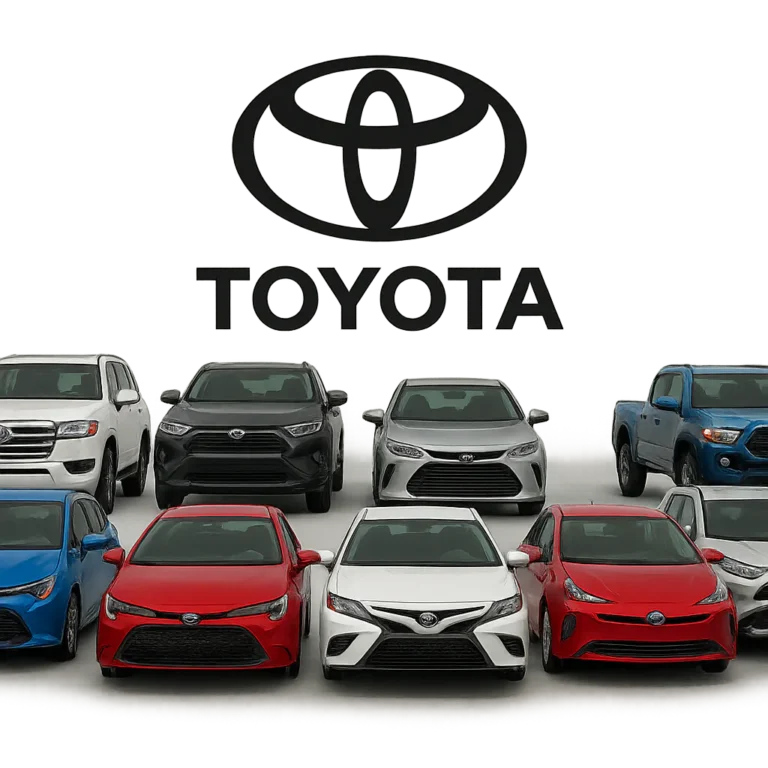
In the cited dataset, Toyota leads the individual-brand ranking, followed by Ford, Chevrolet, and Honda. The exact order—and whether a table calls its measure “sales,” “deliveries,” or “registrations”—should always be checked before comparing it with another report.
| Rank | Brand | 2025 sales | Change vs. 2024 |
|---|---|---|---|
| 1 | Toyota | 2,147,811 | +8.1% |
| 2 | Ford | 2,097,256 | +6.2% |
| 3 | Chevrolet | 1,829,235 | +4.7% |
| 4 | Honda | 1,297,144 | +0.4% |
| 5 | Hyundai | 901,686 | +8.0% |
| 6 | Nissan | 873,307 | +0.9% |
| 7 | Kia | 852,155 | +7.0% |
| 8 | GMC | 652,394 | +6.2% |
| 9 | Subaru | 643,591 | −3.6% |
| 10 | Jeep | 593,401 | +1.0% |
| 11 | Ram | 431,670 | −2.0% |
| 12 | Mazda | 410,346 | −3.3% |
| 13 | BMW | 388,897 | +4.7% |
| 14 | Lexus | 370,260 | +7.1% |
| 15 | Volkswagen | 329,813 | −13.0% |
| 16 | Mercedes-Benz | 303,200 | Not stated |
| 17 | Buick | 198,155 | +8.0% |
| 18 | Cadillac | 173,515 | +8.3% |
| 19 | Audi | 164,942 | −16.0% |
| 20 | Acura | 133,433 | +0.8% |
| 21 | Chrysler | 126,373 | +1.0% |
| 22 | Volvo | 121,607 | −2.9% |
| 23 | Lincoln | 106,868 | +2.0% |
| 24 | Dodge | 101,927 | −28.0% |
| 25 | Mitsubishi | 94,754 | −13.7% |
| 26 | Porsche | 76,219 | Approximately flat |
A few patterns jump out:
- Toyota and Ford are neck-and-neck: The gap is about 50,000 vehicles in this dataset.
- Hyundai and Kia both gained ground, with Hyundai up 8% and Kia up 7%.
- Premium brands occupy a different scale: BMW and Lexus have substantial totals, but their smaller lineups and higher-end positioning make direct comparisons with mass-market brands less meaningful.
- Declines deserve context: A year-over-year drop may reflect model changeovers, reduced inventory, shifts in demand, or reporting differences—not automatically a permanent loss of relevance.
- The source identifies the Ford F-Series as the top-selling model, the Toyota RAV4 as the leading SUV, and the Toyota Camry as the leading car.
For the latest official brand information, see Toyota, Ford, Chevrolet, and Honda. For more comparisons, explore Car Brand Comparisons.
U.S. car sales in full-year 2025 and Q1–Q3 2026
The 2025 figures above are supplied as full-year totals. Full-year 2026 results cannot be stated yet because the year is still underway as of October 2026, and Q1–Q3 totals require a verified, consistent data source. We won’t turn a forecast into a fact just to make a table look tidy.
When comparing 2026 year-to-date reports, keep the following aligned:
- Same reporting window: Compare Q1–Q3 with Q1–Q3, not nine months with a full year.
- Same vehicle scope: Do not mix passenger-car totals with light-vehicle totals.
- Same brand coverage: Note whether all manufacturers are included.
- Same source method: Separate manufacturer-reported sales from registration data.
The BEA motor vehicle sales page and individual automaker investor-relations reports are sensible places to verify current market data. Our Auto Industry News section provides further industry context.
U.S. light-vehicle sales by brand in 2025
The ranked table above gives the full set of brand totals provided by the source. The broad story is a market where Toyota, Ford, and Chevrolet lead by volume, while changes vary sharply underneath them.
| 2025 pattern | Brands highlighted in the dataset | How to interpret it |
|---|---|---|
| Biggest listed growth among leading brands | Toyota +8.1%; Hyundai +8.0%; Kia +7.0% | Strong year-over-year gains, but different sales bases |
| Strong U.S. truck presence | Ford, Chevrolet, GMC, Ram | Light-vehicle totals include trucks and SUVs |
| Major listed declines | Dodge −28%; Audi −16%; Mitsubishi −13.7%; Volkswagen −13.0% | One-year changes need model and supply context |
| Brand-family overlap | Toyota/Lexus; Honda/Acura; Ford/Lincoln | Group and brand tables should not be conflated |
The report notes that brand figures cover around 15.5 million vehicles and may not include every brand or category. It also cautions that manufacturer data can reflect deliveries or other company-defined measures. In plain English: the ranking is useful, but the footnotes ride shotgun.
U.S. light-vehicle sales and market trends in 2026
For 2026, look for the trend beneath the headline: Are a brand’s sales rising faster than the market? Is the gain coming from one popular model or broad demand across its lineup? Are hybrid or electric vehicles contributing, or are trucks and SUVs doing the heavy lifting?
A practical way to read an in-year report:
- Check the date and period. Monthly data can be volatile; year-to-date results smooth some bumps.
- Compare with the same months in the prior year. Seasonal sales patterns can distort simple month-to-month comparisons.
- Look at market share as well as volume. A brand’s sales can rise while its share falls if the total market grows faster.
- Separate group performance from brand performance. A group’s gains may be concentrated in one marque.
- Check model availability and incentives. Supply disruptions and promotions can move deliveries without proving a lasting shift in preference.
Because full-year 2026 figures are not yet complete, verified annual comparisons must wait until the year ends. The habit worth keeping? Read the date stamp before the victory lap.
🚘 North American Light-Vehicle Sales and Brand Share
“North America” is not one uniform car market. The U.S., Canada, and Mexico differ in consumer preferences, production networks, vehicle mix, trade exposure, and how sales data are published. A regional total is helpful, but country-level figures explain more.
North American light-vehicle sales in 2025
The supplied U.S. source reports about 16.3 million light-vehicle sales in 2025, a 2.3% increase. That figure is for the United States, not the whole North American region.
To make a proper regional comparison, add country totals only when they share a compatible definition and period. Check national industry associations and government sources, then record whether the total includes passenger vehicles, light commercial vehicles, or both.
| Comparison point | U.S. | Canada and Mexico |
|---|---|---|
| Market scale | Largest single market in the region | Smaller individual markets |
| Popular vehicle mix | Strong pickup, SUV, and crossover demand | Varies by country and consumer segment |
| Data sources | Automakers, industry reports, government data | National associations and government datasets |
| Caution | Brand tables may omit some manufacturers | Definitions and reporting calendars may differ |
For U.S. context, consult the BEA; for a broader cross-market picture, compare reputable national automotive associations and brand disclosures.
U.S., Canadian, and Mexican market differences
A brand’s regional performance can change with local lineup choices. A truck-oriented brand may have strong U.S. volume, while a compact-car or subcompact SUV lineup can be more relevant in markets where smaller vehicles suit local roads and budgets.
Consider these influences when comparing country rankings:
- Vehicle size and use: Work trucks and family crossovers don’t have equal demand everywhere.
- Local assembly and supply: Plants and regional sourcing can affect availability.
- Import and trade conditions: Tariffs and trade rules shape vehicle pricing and selection.
- Fuel prices and infrastructure: These can influence demand for efficient cars, hybrids, and EVs.
- Brand familiarity and service access: Local dealer networks can build long-term trust.
For enthusiasts, this is where the numbers become a story: one badge can mean an entirely different lineup—and a different kind of driver—across the border.
⚡ Electric-Car Brand Statistics
Electric-vehicle rankings depend on what counts as an EV. Battery-electric vehicles (BEVs), plug-in hybrids (PHEVs), and conventional hybrids are often grouped differently. A source that combines all electrified models may show a very different brand order from a BEV-only leaderboard.
For market definitions and energy context, the International Energy Agency’s Global EV Outlook is a useful reference.
Leading EV brands by sales and market share
Tesla and BYD are prominent names in global electric-vehicle coverage, but the leading brand can vary by region and by whether a ranking counts BEVs only or includes plug-in hybrids. China, Europe, and the U.S. have different brand mixes, incentives, model availability, and charging conditions.
| EV comparison | What to check |
|---|---|
| BEV sales | Battery-electric vehicles only |
| Plug-in sales | Often combines BEVs and PHEVs |
| EV market share | Clarify whether the denominator is all new vehicles or only electrified vehicles |
| Brand versus group | BYD, for example, is a brand and automaker; competitors may be reported at group level |
| Global versus regional | A global total can conceal local leaders |
Don’t assume a high EV share means the same thing in every country. In a market where electric vehicles are already common, brand growth may be hard-earned; elsewhere, a small volume increase can produce a large percentage jump.
Hybrid and plug-in hybrid sales trends
Hybrid statistics can be confusing because “hybrid” covers multiple technologies:
- Conventional hybrid (HEV): Combines an engine and electric motor but is not plugged in.
- Plug-in hybrid (PHEV): Can be charged externally and typically offers a shorter electric-only driving range than a BEV.
- Battery-electric vehicle (BEV): Runs on a battery and electric motor without a combustion engine.
- Mild hybrid: Uses an electric system to assist the engine but generally cannot drive on electric power alone.
Toyota has built a broad hybrid portfolio, while brands including Hyundai, Kia, Ford, and Honda offer different mixes of electrified models. For vehicle-specific technology details, check the respective Toyota, Hyundai, Kia, and Ford sites.
When two reports disagree on “EV sales,” the first thing we check is whether one includes conventional hybrids and the other does not. That tiny acronym can swing the whole chart.
EV adoption by country and region
EV adoption is shaped by more than product appeal. Charging access, electricity costs, incentives, household parking, climate, and vehicle supply all matter. The IEA compares global EV trends and policy conditions, while U.S. Department of Energy vehicle data provides U.S. alternative-fuel and infrastructure information.
A helpful distinction:
- Sales share measures new vehicles sold during a period.
- Fleet share measures EVs among all vehicles already on the road.
- Charging-network density measures access to charging, not vehicle adoption itself.
A region can lead in new-EV sales without having an equally large EV fleet, because vehicles remain on the road for years. Statistics are snapshots; the fleet is the long-running film.
🏆 Brand Rankings by Vehicle Segment
Overall sales favor brands with broad lineups and popular high-volume models. Segment rankings make fairer comparisons between brands serving similar buyers—but even then, vehicle definitions matter. A crossover might be classified as an SUV in one dataset and a passenger vehicle in another.
For side-by-side brand and model research, see Car Brand Comparisons.
Best-selling truck and pickup brands
The U.S. light-vehicle market gives pickup trucks an outsized role. The supplied 2025 report identifies the Ford F-Series as the leading model. But model popularity and brand sales are separate measures: a top-selling truck can bolster a brand’s total without making every model in its lineup a bestseller.
When comparing pickups, look at:
- Model sales and brand totals separately
- Full-size versus midsize truck categories
- Retail sales versus fleet sales, where available
- Year-to-year reporting consistency
- Powertrain mix, including gasoline, hybrid, and electric offerings
Official model information is available from Ford, Chevrolet, GMC, and Ram.
SUV and crossover brand sales
SUVs and crossovers influence brand rankings because they represent a major share of new-vehicle demand in many markets. The cited U.S. report names the Toyota RAV4 as the top-selling SUV in its context. Europe’s 2025 report identifies the Dacia Sandero as the best-selling model overall, illustrating why regional model charts can look very different.
For SUV statistics, distinguish:
- SUVs from crossovers, if the source separates them.
- Individual model sales from all-SUV brand sales.
- Compact, midsize, and full-size categories.
- Retail and fleet volume, where disclosed.
Explore current lineups from Toyota, Honda, and Hyundai.
Luxury-car brand sales and market share
Luxury brands generally sell fewer vehicles than mass-market marques because they operate in narrower segments and may prioritize model mix, margins, or exclusivity over raw volume. The U.S. table places BMW and Lexus among its top 15 brands; European figures rank BMW fourth overall and Mercedes-Benz sixth.
Sales alone do not tell you which luxury brand offers the best ownership experience. Compare them with customer-satisfaction research, warranty coverage, reliability data, dealer experience, and resale studies from sources such as J.D. Power, Consumer Reports, and Kelley Blue Book.
For official model information, visit Lexus, BMW, Mercedes-Benz, and Audi.
Small-car and mainstream brand performance
Mainstream brands often rely on a mix of compact cars, sedans, crossovers, hybrids, and family vehicles. Their sales totals can benefit from broad model availability, while market shifts away from sedans can create pressure for brands with thinner SUV offerings.
To judge performance fairly, compare brands within a similar segment and price class, and include measures beyond sales:
- Reliability: See Consumer Reports.
- Safety: Check the National Highway Traffic Safety Administration and IIHS.
- Resale value: Review Kelley Blue Book and ALG residual-value information.
- Owner experience: Consider survey methods and sample size, not just a star rating.
The most popular brand is not automatically the best fit for your driveway. The best choice is the one whose strengths line up with your needs—and whose weak spots you can live with.
📈 How Car Brand Market Share Changes
Market share moves when customer demand, product launches, factory output, fleet purchases, financing conditions, and competitors’ choices change. One year’s jump may signal a genuine breakthrough—or simply a fresh model arriving at the right time.
Year-over-year growth, declines, and market-share shifts
A brand’s sales growth and market-share growth are not the same thing. If brand sales climb 5% while the whole market rises 8%, the brand sold more cars but lost share.
Use the basic formula:
Change in sales (%) = (current-period sales − prior-period sales) ÷ prior-period sales × 100
For example, the supplied U.S. dataset reports Toyota up 8.1% and the overall light-vehicle market up 2.3%. That indicates Toyota grew faster than the market in that dataset. It doesn’t, by itself, explain why: product mix, availability, hybrid demand, incentives, and other factors may contribute.
What influences brand sales and consumer demand
| Influence | Possible effect on brand statistics |
|---|---|
| New model or redesign | Can draw attention and lift demand |
| Vehicle availability | Limits sales when production or logistics fall short |
| Fuel economy and powertrain options | Can attract buyers facing changing fuel or emissions conditions |
| Consumer confidence | Affects willingness to make a major purchase |
| Financing and incentives | May support near-term demand |
| Dealer network | Shapes access to test drives, service, and inventory |
| Brand reputation | Influences consideration, loyalty, and referrals |
| Competitor launches | Can pull customers toward newer or better-matched products |
Consumer opinions are valuable for understanding the “why,” but they are not the same as sales statistics. Survey results can differ by sample, question, and methodology. We recommend reading the survey’s methodology before treating a satisfaction or reliability score as universal truth.
How incentives, inventory, and supply affect the numbers
A brand can have strong demand and modest sales if it lacks vehicles to deliver. Conversely, promotions or fleet sales can boost volume without proving that private buyers prefer the brand more than before.
Ask these questions:
- Did inventory rise or fall?
- Did the brand launch or discontinue major models?
- Were incentives unusually high or low?
- Did fleet deliveries influence the total?
- Did the reporting source count dealer deliveries or customer registrations?
Anecdotally, we’ve seen enthusiastic shoppers leave a dealership without a car they came to buy—not because they changed their minds, but because the exact trim was unavailable. Sales tables capture the missing transaction, not the conversation that almost happened.
🔎 How to Read and Compare Car Brand Statistics
Good automotive data is less about finding the biggest number and more about knowing what the number counts. Here’s our quick method for separating solid comparisons from statistical apples-to-pickups.
Sales versus deliveries, registrations, and production
These terms often appear side by side, but they describe different points in the vehicle pipeline:
Production → distribution or delivery → customer sale or registration
Not every company reports every step. Some publish wholesales or dealer deliveries; independent sources may track registrations. A vehicle produced near year-end may not be registered until the following period, creating differences even when both sources are accurate.
Why automaker reports can use different methods
Companies may publish data on different schedules and define regional totals differently. Joint ventures, commercial vehicles, incomplete reporting, and brand boundaries can all affect the result. An industry compilation may estimate missing data or separate brands that an automaker groups together.
The supplied U.S. report itself warns that its figures are manufacturer-reported and can represent deliveries rather than final-customer sales or registrations. That is a good example of why an informative table still needs a methodology note.
Common pitfalls when comparing brand rankings
Avoid these frequent traps:
- Comparing different years or reporting windows.
- Mixing brand totals with automaker-group totals.
- Comparing cars-only data with light-vehicle totals.
- Treating a percentage gain as proof of high volume.
- Assuming manufacturer-reported sales equal registrations.
- Ignoring missing brands, estimates, or category exclusions.
- Using sales volume as a proxy for reliability, safety, or satisfaction.
When reports conflict, trust the source that gives the clearest definition, coverage, dates, and methodology. If two reputable sources measure different things, neither may be wrong—they may simply be counting different things.
🕰️ A Brief History of Automotive Brands and Market Leaders

Car-brand rankings have shifted alongside industrial growth, technology, economics, and ownership changes. A nameplate may outlive its original company, join a multinational group, or return after a hiatus. For deeper background, browse Car Brand Histories.
How global automakers and brand portfolios evolved
Automotive groups built brand portfolios to serve different buyers and markets. General Motors’ marques, for example, include Chevrolet, GMC, Buick, and Cadillac; Toyota Motor Corporation operates Toyota and Lexus; BMW Group includes BMW and MINI.
The featured video’s regional tour—Asian, American, and European marques—helps make this ownership web easier to picture. Its “Function vs. Fashion” framing is a playful way to discuss brand positioning, but it is a point of view, not a measured sales or quality statistic. For ownership histories and current lineups, check official company sources such as GM, Toyota, BMW Group, and Volkswagen Group.
How today’s sales leaders rose to the top
Brands build market position through a mix of product range, manufacturing scale, customer trust, dealer coverage, and the ability to adapt. A popular model can become anchor; a range of practical, fuel-efficient, or locally produced vehicles can help a brand remain competitive.
But history doesn’t guarantee the next ranking. Established players can lose share when products or supply miss the moment, while a smaller brand can grow quickly from a low base. The numbers are less a permanent trophy cabinet than a running race.
🔮 Car Brand Statistics to Watch

The next wave of rankings will be shaped by powertrain choice, regional manufacturing, software and connected services, model launches, and the cost of ownership. Sales charts tell us what moved; they don’t always tell us what ownership feels like.
Key trends shaping the next sales rankings
Keep an eye on:
- EV and hybrid mix: Separate BEV, PHEV, and HEV data before comparing brands.
- Regional growth: Fast expansion in one market may not translate to global leadership.
- Model concentration: A brand leaning heavily one bestseller may be vulnerable to a redesign or supply interruption.
- Group versus brand performance: Corporate totals can mask winners and lagards within a portfolio.
- Resale, reliability, and satisfaction: These give important ownership context beyond sales volume.
- Connected-car privacy: More digital features can bring additional data-collection questions.
Mozilla’s Privacy Not Included project reviewed 25 major car brands across five countries and reported that all failed its privacy assessment; its review involved around 600 hours of research into policies, apps, and company responses. That is Mozilla’s assessment, not a government certification or a universal technical audit. Still, it raises a practical consumer question: what data does a connected car collect, and how can you control it?
Read Mozilla’s report, Privacy Nightmare on Wheels, and check the privacy policy for the specific vehicle, app, and connected service you use. Data practices can differ by market, model, and feature.
Where to find the latest automotive sales reports
For better fact-checking, combine sources instead of relying on a single league table:
| Source | Useful for |
|---|---|
| Automaker investor-relations reports | Company and brand-reported sales, deliveries, and financial context |
| U.S. Bureau of Economic Analysis | U.S. motor vehicle sales data |
| ACEA | European registrations and industry statistics |
| International Energy Agency | Global electric-vehicle trends |
| NHTSA and IIHS | Vehicle safety ratings and research |
| J.D. Power and Consumer Reports | Owner-focused studies, reliability, and satisfaction context |
For a regional example, the 2025 Europe report states that EU, UK, and EFTA registrations reached 13,271,270, up 2.4%. It places Volkswagen Group first among manufacturer groups and Volkswagen first among brands; Škoda rose to third among brands, BYD’s sales climbed sharply from a smaller base, and Tesla declined. Those are European registration figures, so they shouldn’t be merged directly with U.S. manufacturer-reported sales.
The report’s wording that Tesla was “the worst-performing major brand” describes its result within that European dataset—not a verdict on every global market or every measure of performance. For the full country-and-brand breakdown, see 2025 (Full Year) Europe: Best-Selling Car Manufacturers and Brands.